Life on a Leaf: Celebrating Caterpillars and Host Plants
We are pleased to showcase the 2026 Pollinator Poster titled "Life on a Leaf: Celebrating Caterpillars and Host Plants". This year’s design pairs 19 caterpillar species with the host plants they depend on, resulting in a vibrant and detailed guide to these essential connections.
Poster Artist: Avani Hope
Dimensions: 20" x 30"
Get Posters before Pollinator Week- June 22-28, 2026
Order Yours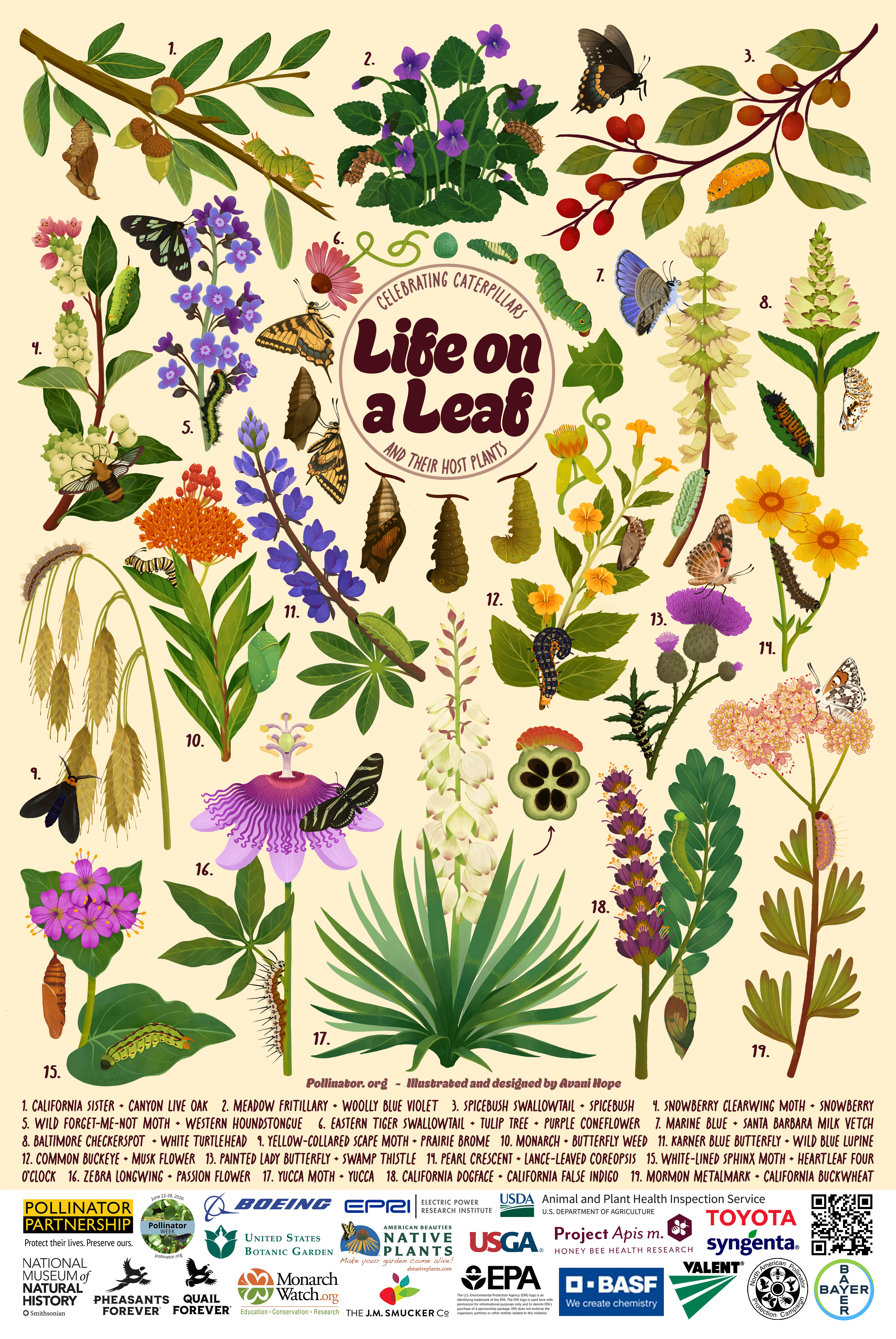
Meet the Artist

Avani Hope is an illustrator and concept artist raised on Florida’s sunny Atlantic coast. As far back as she can remember, she has always been happiest when creating art. Growing up so close to the sea, her family often volunteered with ocean conservation teams and wildlife rescue efforts. These early experiences instilled in her a deep love and respect for the Earth and all its creatures. She is a proud graduate of Ringling College of Art and Design, with a degree in Illustration and a minor in art history. Although Avani works primarily as a character designer and narrative illustrator, she has always found immense beauty in the designs of nature. She often finds herself looking towards the natural world as a source of inspiration. She is currently pursuing a master’s in art conservation and is furthering her artistic studies through her additional course work in print making, fiber arts, and sculpture. She works full time as a freelance artist with a wide variety of work in visual development, graphic design, and fine art. You can follow her journey on Instagram @avani.hope or check out her portfolio at avanihope.com
Meet the Caterpillars and their Host Plants
#1 California Sister (Adelpha californica) and Canyon Live Oak (Quercus chrysolepis)
California Sister (Adelpha californica) larvae. Photo: Ken-ichi Ueda CC BY
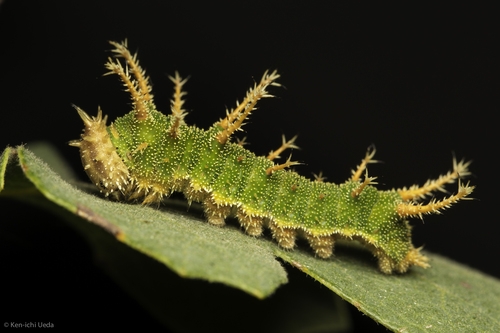
California sister, a species of butterfly found primarily in California, Oregon, and northern Nevada, can be found residing in foothills and mid-elevation mountains hosting small streams. This species can be identified by their brown-black color, a white band placed on their dorsal forewing, and yellow patches on each side of their forewing. A predominant host plant of the California sister is the canyon live oak, a tree that is native to the California coastal ranges and parallels the California sister’s preference for moist habitats near creeks and streams. While much of the California sister’s food foraging habits focus on mud, water, and fallen fruit, they frequently sip nectar from the canyon live oak’s yellow flowers that bloom in the fall.
For further reading:
https://calscape.org/Quercus-chrysolepis-(Canyon-Live-Oak)
https://www.butterfliesandmoths.org/species/Adelpha-californica
#2 Meadow Fritillary (Boloria bellona) and Woolly Blue Violet (Viola sororia)
Meadow fritillary (Boloria bellona) larvae. Illustration: Avani Hope
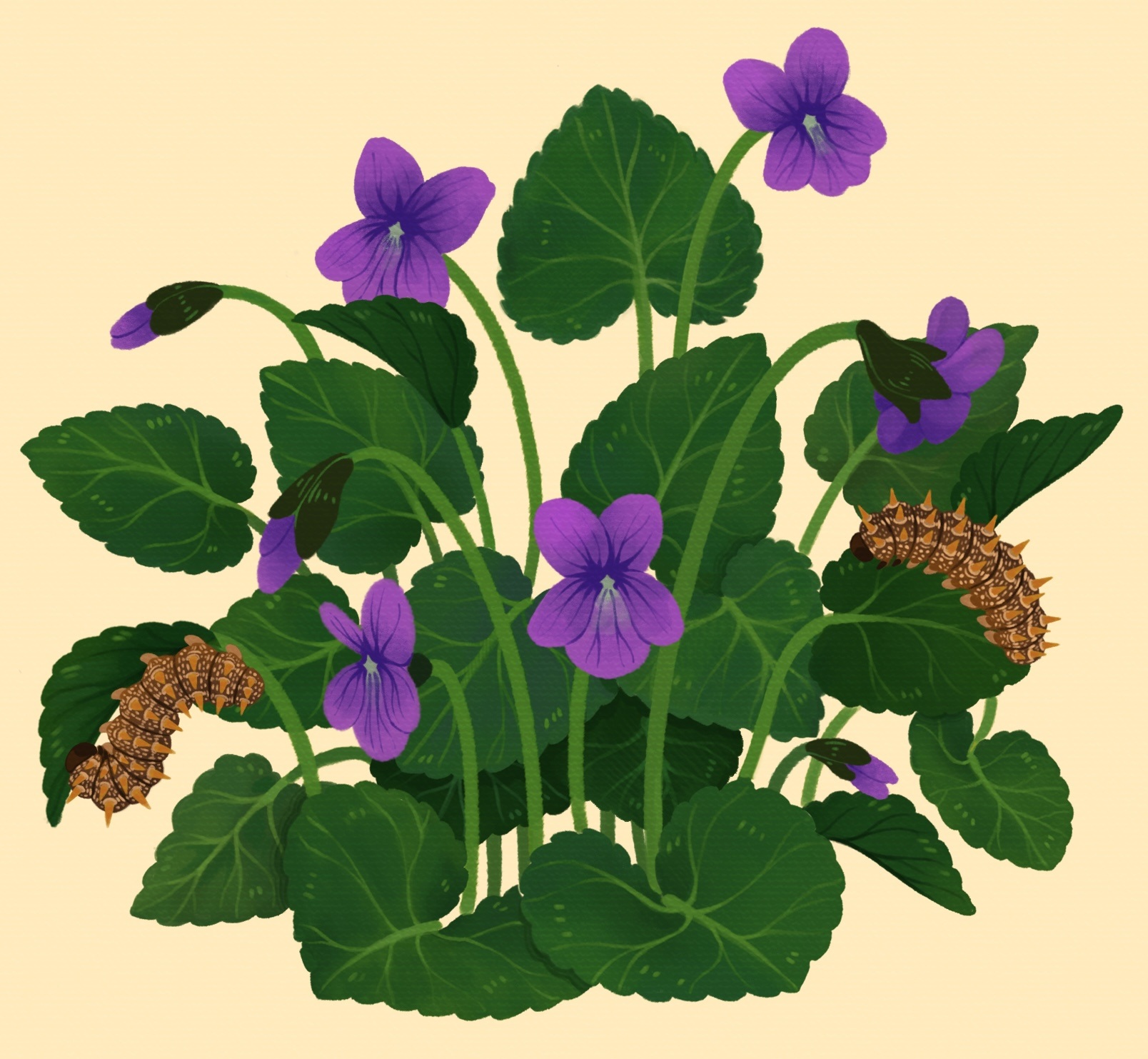
The meadow fritillary butterfly, recognizable by its bright orange wings and distinctly clubbed antenna, can be found throughout Southern Canada and into the northern United States. Researchers have found that populations of this butterfly are more resilient to disturbance when compared to closely related species, but habitat loss and land use change still affect meadow fritillaries by limiting the availability of their host plants. As its name suggests, the meadow fritillary thrives in open meadow ecosystems where its larval host, the woolly blue violet (Viola sororia), thrives. Males fly in jerky circles low to the ground to find mates, and females can lay up to 85 eggs at a time on a single host plant!
For further reading:
https://wildadirondacks.org/adirondack-butterflies-meadow-fritillary-boloria-bellona.html
#3 Spicebush Swallowtail (Papilio troilus) and Spicebush (Lindera benzoin)
Spicebush Swallowtail (Papilio troilus). Photo: David Eberly
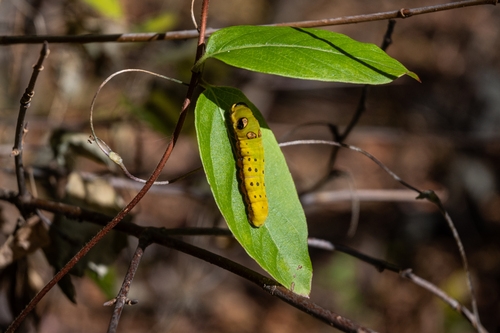
Aptly named, the spicebush swallowtail (Papilio troilus) is particularly adept at homemaking when paired with its host plant: spicebush (Lindera benzoin). Female butterflies lay individual eggs on the underside of the host plant’s leaves, and when hatched, the caterpillars fold the leaves to create a makeshift shelter that they come out of at night to feed. The caterpillars are adorned with large eyespots to deter predators, and after metamorphosis, the matured butterflies emerge with a black body with blue-green scales, as well as ivory, orange, and pale green spots. The spicebush swallowtail is found through the much of the Eastern, Midwestern, and Southeastern United States, as well as Southern Canada. Their habitat can be found in pine barrens, deciduous forests, fields, wooded swamps, and along roadsides where they find their food in the form of nectar from a variety of plants.
For further reading:
https://content.ces.ncsu.edu/spicebush-swallowtail
https://www.butterfliesandmoths.org/species/Papilio-troilus
#4 Snowberry Clearwing Moth (Hemaris diffinis) and Snowberry (Symphoricarpos albus)
Snowberry Clearwing Moth (Hemaris diffinis) larvae. Photo: Trevor Clarke
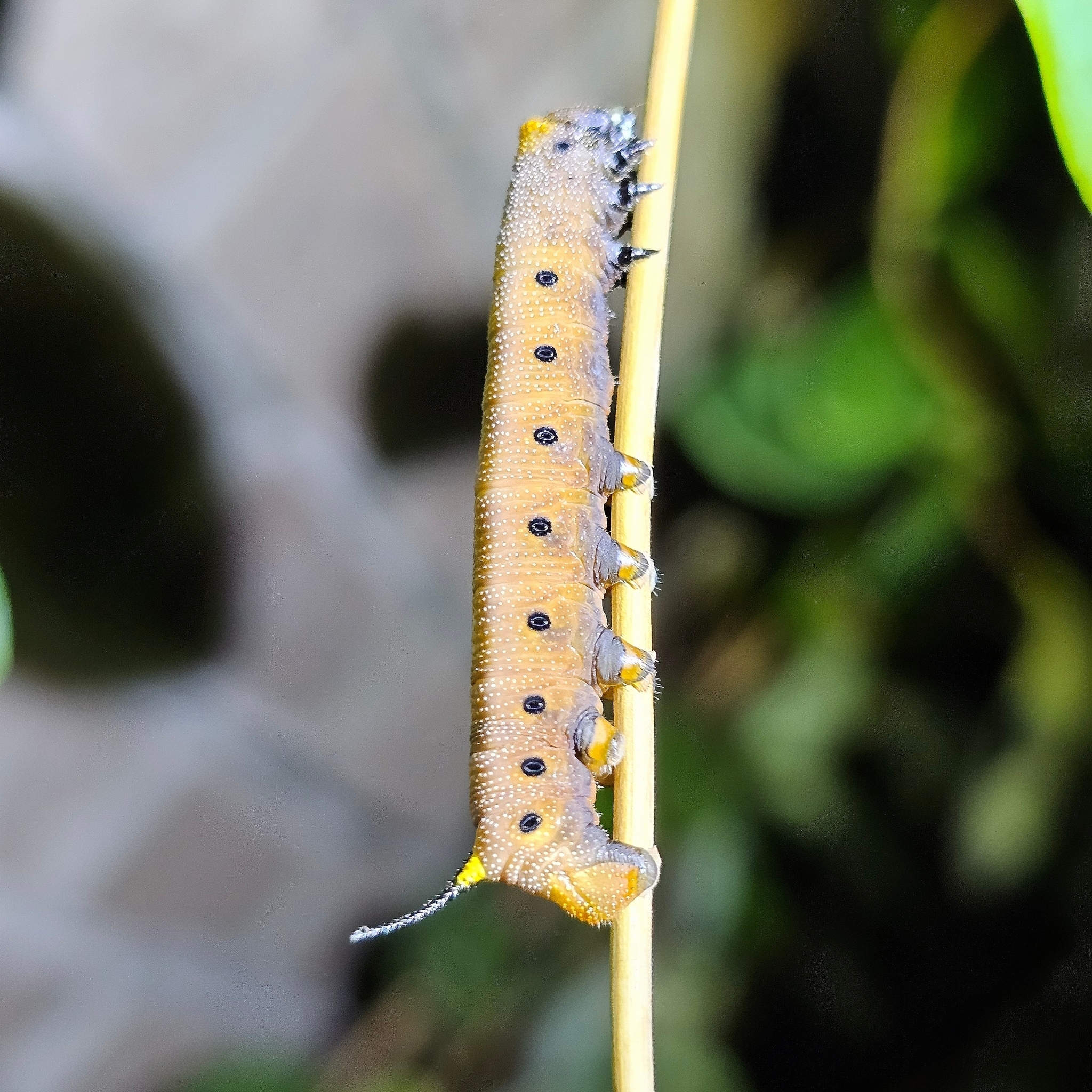
Unlike most butterflies and moths, the snowberry clearwing moth (Hemaris diffinis) has transparent wings, much like those of a bumblebee. In fact, this fascinating moth has several adaptations to seem like it has a painful sting, including a round fuzzy abdomen with yellow and orange banding, as well as a loud and bumbling flight pattern. Other moths in the sphinx family (Sphingidae) mimic hummingbirds and can be found day-flying around your garden and inserting their long proboscis into tube-shaped flowers while hovering in the air. Snowberry clearwing moth larvae feed exclusively on plants in the honeysuckle family (Caprifoliaceae), with the snowberry (Symphoricarpos albus) being their preferred host species. While the adults nectar on all kinds of flowers, you’ll often see them around snowberry plants where they lay their eggs on the underside of leaves.
For further reading:
https://www.fs.usda.gov/wildflowers/pollinators/pollinator-of-the-month/hummingbird_moth.shtml
#5 Wild Forget-Me-Not-Moth (Gnophaela latipennis) and Western Houndstongue (Adelinia grandis)
Wild Forget Me Not Moth (Gnophaela latipennis) larvae. Photo: Peter Garber
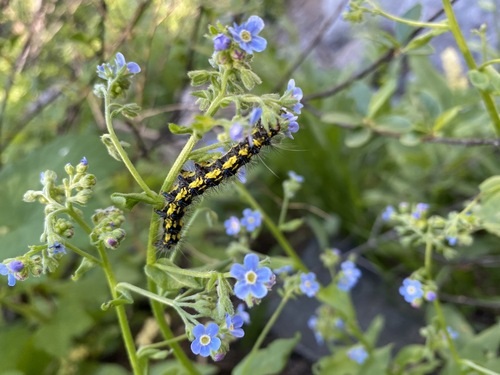
The Wild Forget-Me-Not Moth (Gnophaela latipennis), regionally restricted to Oregon and California, can be found in oak woodlands, open mixed hardwood-conifer forests, and open riparian areas, as well as open ponderosa pine forests and mountain meadows east of the Cascades. Unlike most moth species, the Wild Forget-Me-Not is diurnal, meaning they are active during the daytime. The host plant of the Wild Forget Me Not is the Western Houndstongue (Adelinia grandis), a plant species native from California up to British Columbia. Western Houndstooth is a perennial herb that has blue or purple flowers.
For further reading:
https://calscape.org/lep/Gnophaela-latipennis-(Wild-Forget-Me-Not-Moth)?srchcr=sc631a1884ed0ea
https://www.inaturalist.org/taxa/63790-Gnophaela-latipennis
#6 Eastern Tiger Swallowtail (Papilio glaucus) and Tulip Tree (Liriodendron tulipifera) and Purple Coneflower (Echinacea purpurea)
Eastern Tiger Swallowtail (Papilio glaucus) larvae. Photo: Elle Dee Eff.
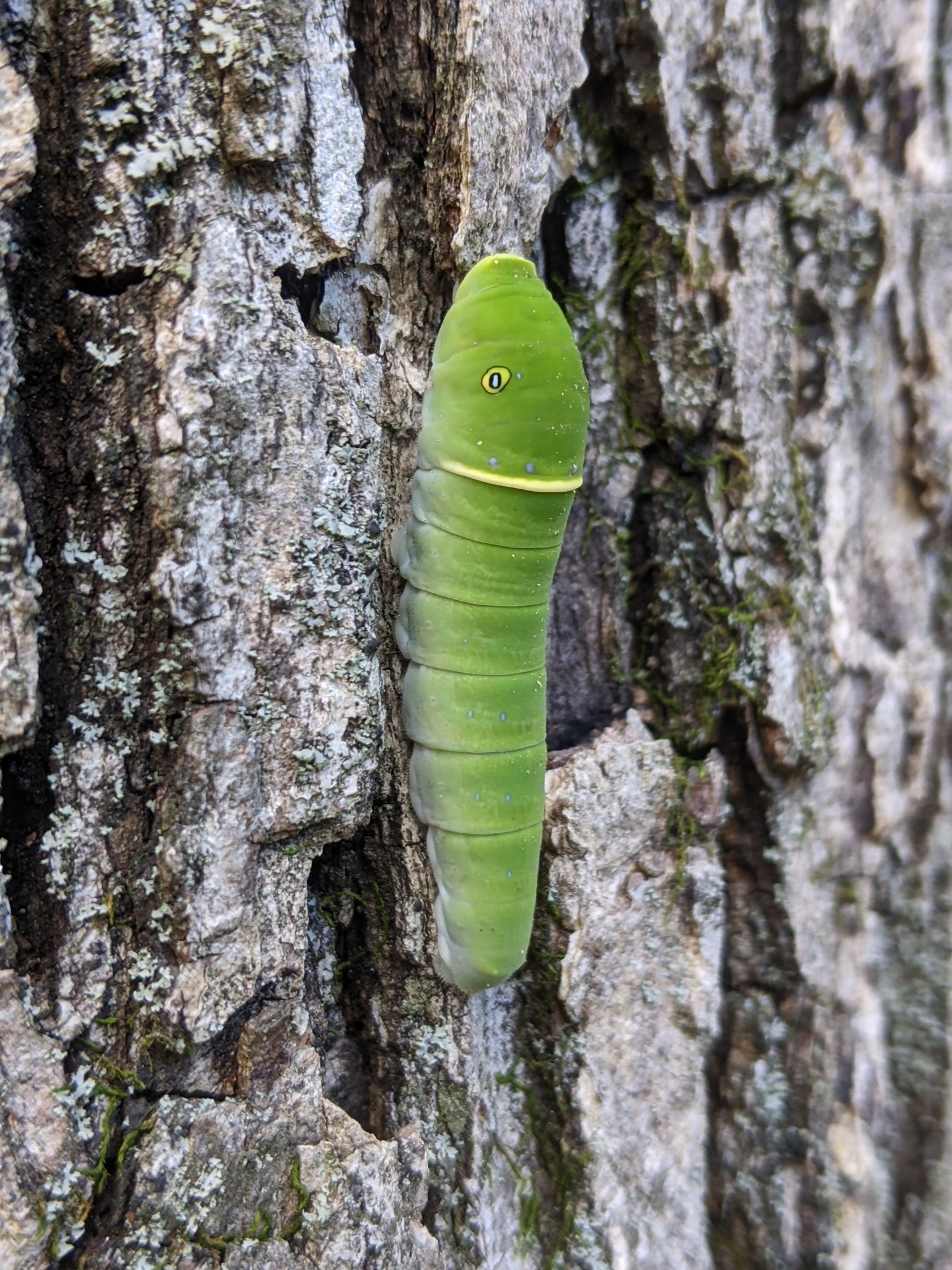
The Eastern tiger swallowtail (Papilio glaucus) is one of North America’s showiest butterflies, sporting large and beautifully patterned wings with elongated wing tips characteristic of swallowtail butterflies. These amazing insects have a close relationship with their larval host plants in the magnolia family, notably the tulip tree (Liriodendron tulipifera). As newly hatched caterpillars, swallowtails resemble bird droppings; a clever use of mimicry employed to seem unappealing to predators. As they grow, they switch tactics, developing large eyespots and a forked structure that protrudes from their head when alarmed to look like the tongue of a snake. To the untrained eye of a predator, they look just like a snake rearing its head. As adults, Eastern tiger swallowtails come in yellow and black color morphs and sip on nectar from a variety of flowers, including the purple coneflower (Echinacea purpurea).
For further reading:
https://www.fs.usda.gov/wildflowers/pollinators/pollinator-of-the-month/TigerSwallowtail.shtml
#7 Marine Blue (Leptotes marina) and Santa Barbara Milk Vetch (Astragalus trichopodus)
Marine Blue (Leptotes marina) larvae. Photo: Vijay Barve
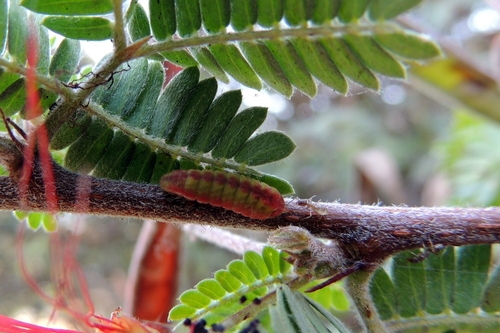
The marine blue butterfly (Leptotes marina), named after their beautiful, luminous color, is found in subtropical and arid Southwestern open spaces such as fields, deserts, and even waste areas. They range from Southern California to the Southwestern United States, as well as Mexico, Baja California, and Guatemala. Sometimes when they take flight from the late spring to early fall, they wander outside of their typical range and have been noted to establish as far north as Wisconsin. On their host plants, including the Santa Barbara milk vetch (Astragalus trichopodus), the Marine Blue lays individual eggs on flower buds. After hatching, the caterpillars feed on the flowers and seed pods of the host plant.
For further reading:
https://www.butterfliesandmoths.org/species/Leptotes-marina
#8 Baltimore Checkerspot (Euphydryas phaeton) and White Turtlehead (Chelone glabra)
Baltimore checkerspot (Euphydryas phaeton) larvae. Photo:
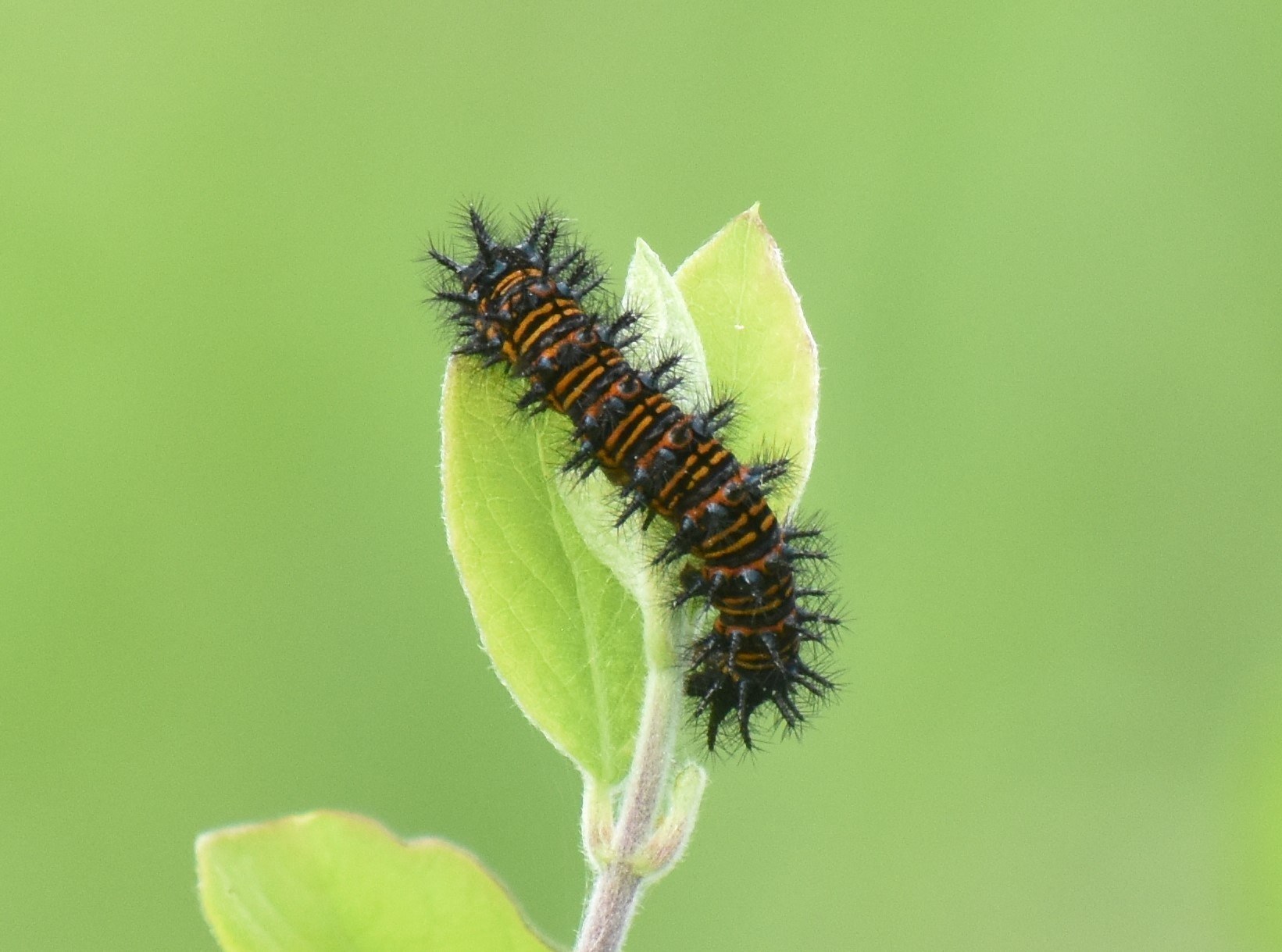
The Baltimore checkerspot’s name has an interesting history, derived from its historic abundance in Maryland and the orange checkered patterns boarding its wings that resemble the shield of Geroge Calvert, the first lord of Baltimore. The white turtlehead plant (Chelone glabra) is its primary larval host. Though toxic to humans and mammals, caterpillars of the Baltimore checkerspot (Euphydryas phaeton) consume this plant’s leaves which give it a bitter and astringent taste to predators. With only one generation emerging per year and shrinking habitat availability, Baltimore checkerspot populations are experiencing regional declines. However, some populations of this butterfly have been observed expanding their host plant preferences to include English plantain (Plantago lanceolata), a non-native perennial plant introduced from Eurasia in the 19th century.
For further reading:
#9 Yellow-Collared Scape Moth (Cisseps fulvicollis) and Prairie Brome (Bromus kalmii)
Yellow-Collared Scape Moth (Cisseps fulvicollis) larvae. Photo: James Adney
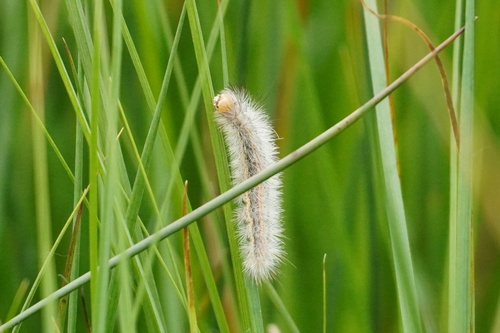
The yellow-collared scape moth’s name provides an interesting window into English linguistics. The evident yellow band around the moth’s neck resembles a collar, while the word “scape” is defined as an elongated stalk or shaft and is linked to the moth’s name due to their long antennae. Widespread throughout North America, the yellow-collared scape moth (Cisseps fulvicollis) is abundantly found in open, sunny areas such as prairies, fields, and roadsides. One of many of their host plants is Prairie Brome (Bromus kalmii), a perennial grass. Prairie Brome can be found in Southern Canada, as well as the Northeastern and Northcentral United States. As this grass produces heavy seeds, it gently begins to bow towards the ground under its own weight.
For further reading:
https://www.prairiemoon.com/bromus-kalmii-prairie-brome#panel-descrip
https://mdc.mo.gov/discover-nature/field-guide/yellow-collared-scape-moth
#10 Monarch (Danaus plexippus) and Butterfly Weed (Asclepias tuberosa)
Monarch (Danaus plexippus) larvae. Photo: Hanwen
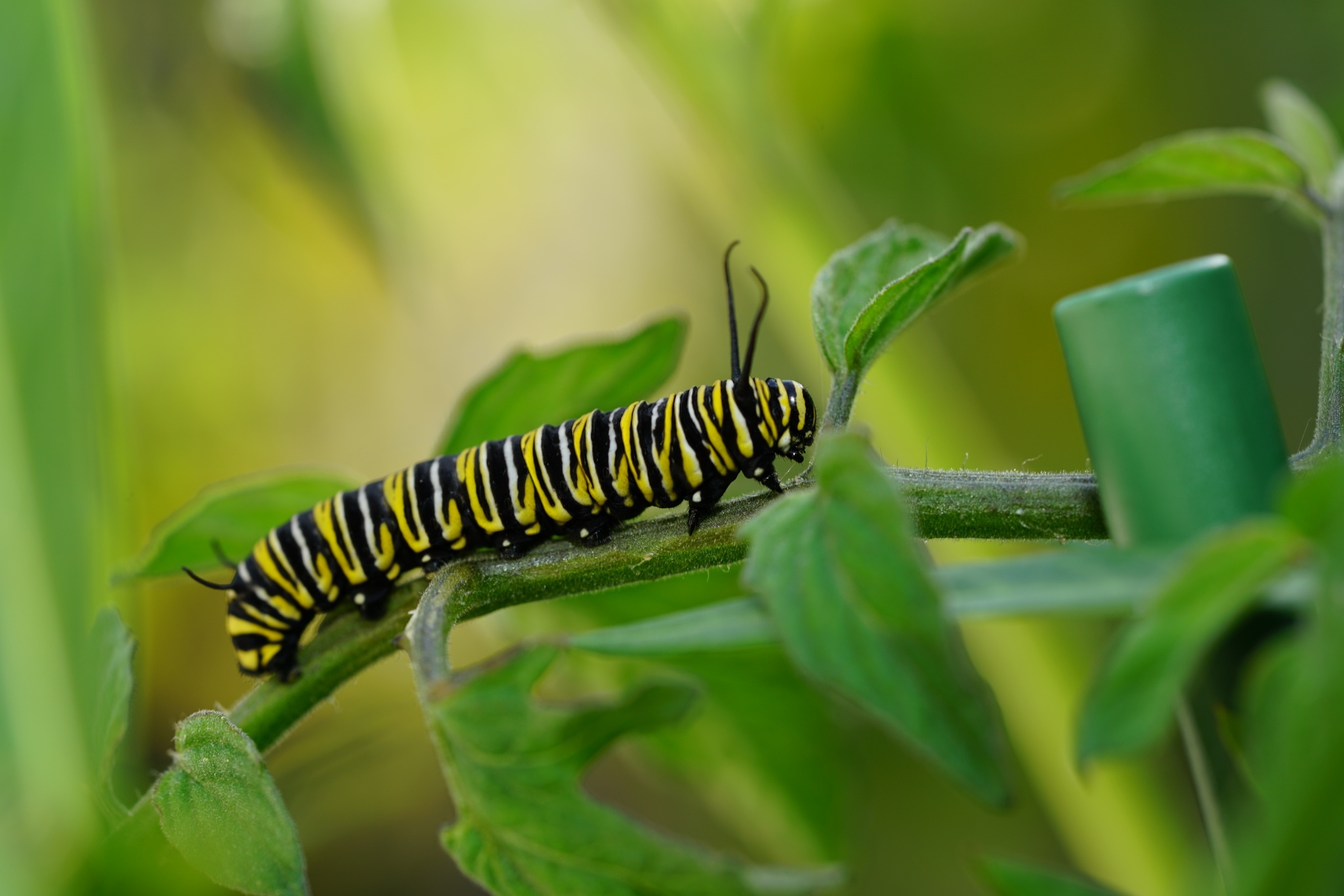
Perhaps the most iconic symbol of insect conservation, the monarch butterfly has catalyzed decades of habitat preservation, decreased pesticide use, and environmental stewardship across North America as communities take action to reverse its decline. Adult monarch butterflies (Danaus plexippus) flaunt beautiful orange wings traced with black streaks and scattered with white spots. Their caterpillars are vividly striped, black, white, and yellow and have four filaments that protrude from their head and tail. They are exclusively reliant on milkweed species (Asclepias) for reproduction and obtain noxious chemicals from the leaves as caterpillars that make them unpalatable to predators. Populations of monarchs around North America feed on different milkweed species regionally, with butterfly weed (Asclepias tuberosa) being one important native host species in parts of the eastern United States. Though its orange flowers may look like those of tropical milkweed (Asclepias curassavica), it is important to avoid planting the latter in areas where migratory populations of monarchs reside. Tropical milkweed blooms year-round and cannot provide the cues necessary to trigger monarch migration while also harboring the parasite Ophryocystis elektroscirrha (OE) which dramatically decreases the survival rate of monarchs.
For further reading:
https://www.pollinator.org/monarch
#11 Karner Blue Butterfly (Plebejus samuelis) and Wild Blue Lupine (Lupinus perennis)
Karner Blue Butterfly (Plebejus samuelis) larvae. Photo: Barillium CC-NY-BC
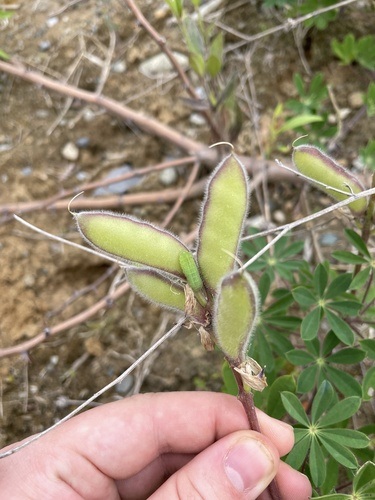
The Karner blue butterfly (Plebejus samuelis), is a species that is regionally restricted by the availability of their host plants, lupines, such as the wild blue lupine (Lupinus perennis). The Karner blue occupy a narrow range in the Great Lakes and Northeastern U.S. where wild blue lupine is found. To access the sunny, open spaces where lupine species grow, the habitat that the Karner blue butterfly frequents is reliant on the presence of fire or other forms of disturbance. The caterpillars have a fascinating mutualistic relationship with ants, in which the caterpillars secrete a liquid which provides food for the ants, while the ants offer in return protection from certain predators and parasites. In the butterfly’s short lifespan of only a few days or weeks, they develop a violet blue color which parallels their lupine host plant. Due to fire suppression and habitat loss, the Karner blue butterfly has been endangered since 1992, and entire state populations have been eradicated. Conservation efforts such as habitat management, controlled burns, and research aid the stabilization and recovery of the Karner blue’s populations.
For further reading:
https://www.fs.usda.gov/wildflowers/pollinators/pollinator-of-the-month/karner_blue_butterfly.shtml
https://www.butterfliesandmoths.org/species/Plebejus-melissa
#12 Common Buckeye (Junonia coenia) and Musk Flower (Erythranthe moschata)
Common Buckeye (Junonia coenia) larvae. Photo: Mikoikoi
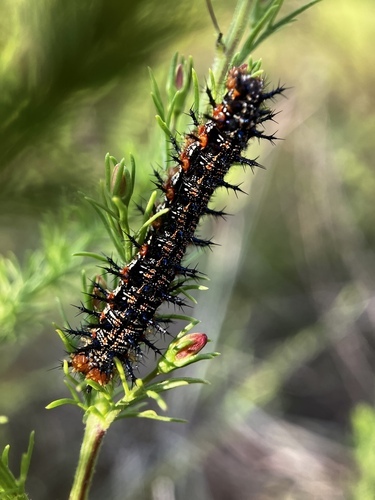
The common buckeye butterfly (Junonia coenia) has a wide range and can be found from California all the way to Florida, though the majority of its population is concentrated in the Eastern United States. Its larval host plants include the Musk Flower (Erythranthe moschata), a low growing perennial with yellow flowers that emit a rich musky scent, though the common buckeye can reproduce on other plants in the Snapdragon family. Like other butterflies in the Nymphalidae family, the common buckeye holds a pair of its legs close to its body, giving it the appearance of only having four legs, and displays prominent eyespots on its hind wings. Caterpillars of this species ward off predators with rows of spines extending down their bodies. While these barbs may look threatening, they do not contain any volatile compounds and serve only as mechanical defense.
For further reading:
https://www.butterfliesandmoths.org/species/Junonia-coenia
#13 Painted Lady Butterfly (Vanessa cardui) and Swamp Thistle (Cirsium muticum)
Painted lady butterfly (Vanessa cardui) larvae. Photo: Vladimir Bryukhov CC BY-NC
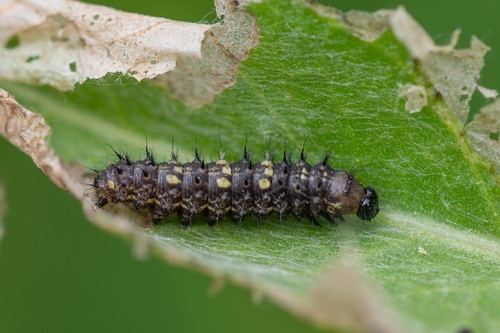
With a global reach, the painted lady butterfly (Vanessa cardui) can be found across North America, Central America, Africa, Europe, and Asia. In fact, the only continents not inhabited by this species are Australia and Antarctica. Often referred to as “Cosmopolitan”, they are one of the most widely distributed butterfly species in the world. As one might assume by their expansive range, the painted lady is suited to most habitat types, especially ones which feature higher levels of disturbance. Painted lady butterflies are also nicknamed thistle butterflies due to their affinity towards thistle species as host plants and food sources, including the Swamp Thistle (Cirsium muticum). The caterpillars are adorned with spikes, and the butterflies have an orange, black spotted “leopard print” coloration on their upper wings.
For further reading:
https://www.butterfliesandmoths.org/species/Vanessa-cardui
#14 Pearl Crescents (Phyciodes tharos) + Lance-Leaved Coreopsis (Coreopsis lanceolata)
Pearl Crescents (Phyciodes tharos) larvae. Photo: Jedd Niznik CC BY-SA
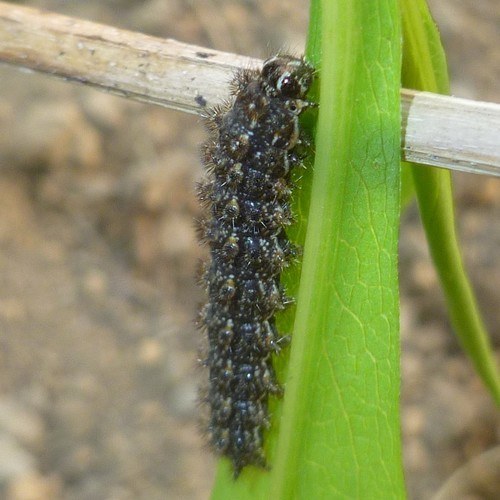
The pearl crescent butterfly (Phyciodes tharos) earned its name from the white half-moon shaped markings boardering its hind wings. From over 700 species, the pearl crescent is one of the most common species of butterflies in the United States and Canada, though it has many lookalikes. Several subspecies have been identified, though there is some disagreement between researchers as to whether these are truly new species, hybridizations of existing species, or regionally distributed subspecies. Pearl crescent caterpillars only eat host plants in the Aster family, but adults nectar on a wide array of plants, including the Lance-Leaved Coreopsis (Coreopsis lanceolata).
For further reading:
https://animaldiversity.org/accounts/Phyciodes_tharos/
#15 White Lined Sphinx Moth (Hyles lineata) and Heartleaf Four O’Clock (Mirabilis nyctaginea)
White Lined Sphinx Moth (Hyles lineata) larvae. Photo: Zoltán Stekkelpak
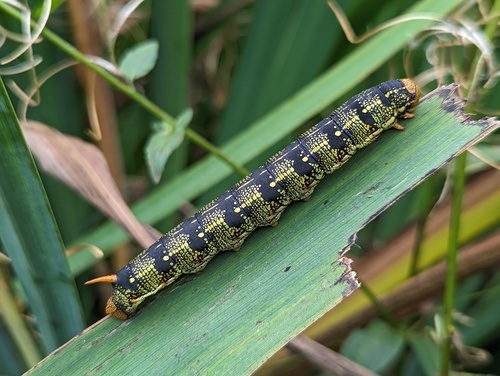
Also known as the hummingbird moth due to its similar size and hovering flight patterns, the white lined sphinx moth (Hyles lineata) can be found throughout the United States, Canada, Mexico, and Central America, as well as certain regions of Eurasia and Africa. The origination of the sphinx naming comes from the caterpillars resting position, their upper bodies positioned upright, similar to the Great Sphinx statue of the Egyptian pyramids. The adults feature a large, furry body, while the caterpillars can be identified by their small horns. Larval white lined sphinx moths pupate in shallow ground burrows, while the adults emerge in the spring and take flight in the evenings in search of nectar. One of their host plants, heartleaf four o’clock (Mirabilis nyctaginea), aligns with the white lined sphinx’s evening proclivity, the family name of four o’clock referencing the time of day the floral blooms appear.
For further reading:
https://www.flawildflowers.org/know-your-native-pollinators-white-lined-sphinx-moth/
https://www.wildflower.org/plants/result.php?id_plant=miny
https://www.butterfliesandmoths.org/species/Hyles-lineata
https://extension.usu.edu/rangeplants/forbs-herbaceous/four-oclock
#16 Zebra Longwing (Heliconius charithonia) and Passion Flower (Passiflora incarnata)
Zebra longwing (Heliconius charithonia). Photo: Connie Nagele
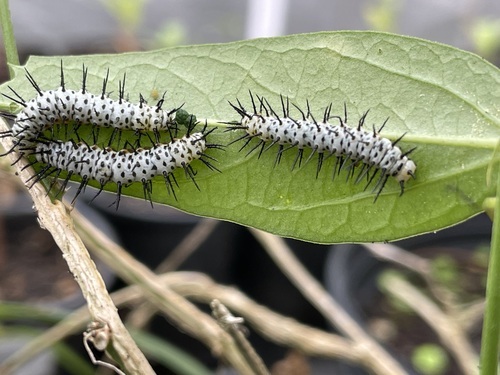
With its beautifully striped and elongated wings, the Zebra Longwing butterfly (Heliconius charithonia) is a striking pollinator with a specialized relationship to the equally striking passion flower vine (Passiflora incarnata). Flowers of this species have a whimsical look with thin, wavy, purple petals that extend from a pink center. After pollination, passion flower plants produce edible fruits filled with sour seeds, very similar to the closely related passion fruit. The flower’s reproductive parts (stamens and anthers) rest at the perfect height to brush the hairy backs of large-bodied bees, like carpenter bees (Xylocopa spp.) and bumble bees (Bombus spp.). However, zebra longwings, the state butterfly of Florida, also play a role in pollen transport and only lay their eggs on passion flower vines. If you’re lucky you might find a group of adult zebra longwing butterflies sleeping together under the foliage of a passion flower, or a chrysalis camouflaged as a dead leaf ready to reveal this beautiful butterfly.
For further reading:
https://www.flawildflowers.org/know-your-native-pollinators-zebra-longwing/
#17 Yucca Moth (Tegeticula yuccasella) and Yucca (Yucca glauca)
Yucca Moth (Tegeticula yuccasella) larvae. Photo: Dan L. Johnson CC BY-NC
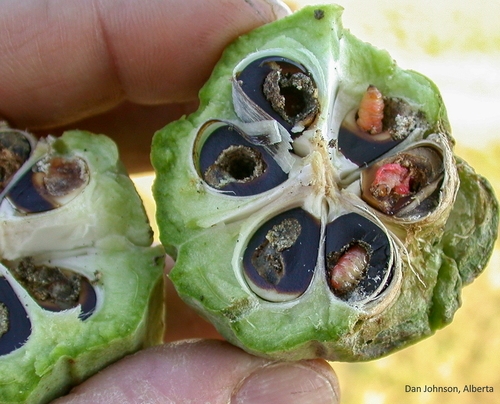
The relationship between the yucca plant (Yucca glauca) and the yucca moth (Tegeticula yuccasella) is one that scientists believe evolved from parasitism, to mutualism to complete interdependence. The yucca moth, a small, white species, has such a short lifespan that the adults do not feed. After the springtime mating season, the females gather pollen from the yucca plant using their unique tentacles located around their mouths, carrying clumps of pollen from one plant’s inflorescence to an entirely different plant. This in turn leads to the cross-pollination of the yucca plant. Making certain that the flower is in the right stage and that no other eggs have been laid there, the female moth lays a small number of eggs in the ovary of the flower. She then places the pollen onto the stigma of the flower, setting the stage for the flower to produce seeds and fruit that the larval moth will feed on as they develop. Many Tegeticula species exploit their host plants, but the evolution of the yucca and yucca moth’s relationship has resulted in a deeply fascinating interdependence.
For further reading:
https://www.fs.usda.gov/wildflowers/pollinators/pollinator-of-the-month/yucca_moths.shtml
#18 California Dogface (Zerene eurydice) + California False indigo (Amorpha californica)
California Dogface (Zerene eurydice). Photo: robertgorman CC BY-NC
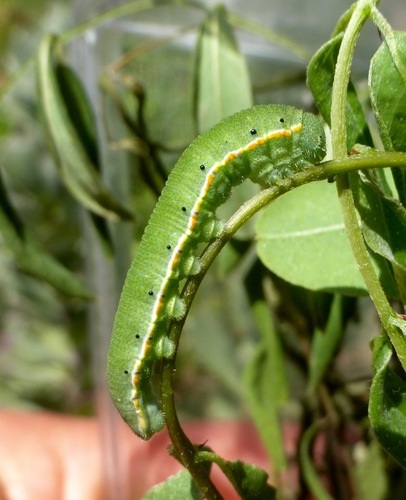
The California Dogface butterfly (Zerene eurydice) is the state butterfly of California. It is endemic to the state, with populations existing from north-central California down to Baja California, but nowhere else in the country. Adult male and female butterfly display sexual dimorphism and are quite distinct. Females are a uniform pale yellow, with two black spots on their forewings, while the forewings of male butterflies are black around the edges, leaving a shape that resembles a dog’s head and giving these butterflies their name. California dogface butterflies are incredibly important pollinators of California’s native plants, and only lay eggs on California false indigo (Amorpha californica).
For further reading:
#19 Mormon Metalmark (Apodemia mormo) + California Buckwheat (Eriogonum fasciculatum)
Mormon Metalmark (Apodemia mormo) larvae. Photo: James Bailey CC BY-NC
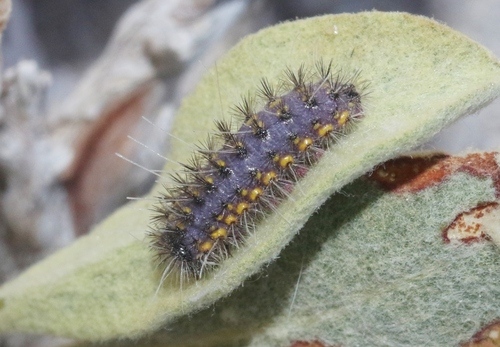
The Mormon Metalmark (Apodemia mormo) is a butterfly species found throughout the western half of the United States, primarily in the Pacific Northwest and California, but some have been recorded as far east as North Dakota. They are orange and brown in color, checkered with black and white spots. The northern populations take flight from summer to early fall, while their southern counterparts range from March to October. Males wait in hillside burrows for females, and after mating, they take to various buckwheat species, their preferred host plants, to lay their young. In Southern and Central California, California Buckwheat (Eriogonum fasciculatum) is an often-frequented host species. California Buckwheat and Mormon Metalmark both thrive in arid habitat conditions, making them suitable partners.
For further reading:
https://www.butterfliesandmoths.org/species/Apodemia-mormo
https://calscape.org/Eriogonum-fasciculatum-%28California-Buckwheat%29
Pollinator and Planting Resources
Native Garden Recipe CardsHost Plant Garden Recipe Cards