Meet the Native Bees Pollinating Specialty Crops by Ella Stroh, Indiana Partner Biologist, Pollinator Partnership
Published March 12, 2026
Insects, particularly bees, are some of the world’s most important pollinators; 35% of global crop production relies on insect pollination, meaning they are responsible for approximately one in three bites of food we eat. Specialty crops, like fruits and vegetables, are among the most heavily pollinator-reliant foods. The United States is home to 4,000 native bee species that help provide these crucial pollination services. Unlike honey bees, most native bees are not managed by humans or kept in colonies. They live wild on the landscape, visiting crop flowers according to their preferences and abilities. Recognizing and appreciating native bees is an important part of understanding their value for our agroecosystems. Several common native bees in the Midwestern U.S. are described below, along with the crops they pollinate, and tips and tricks for their identification.
Native Bee Profiles
Mining bee on Golden Alexander. Photo: Amber Barnes
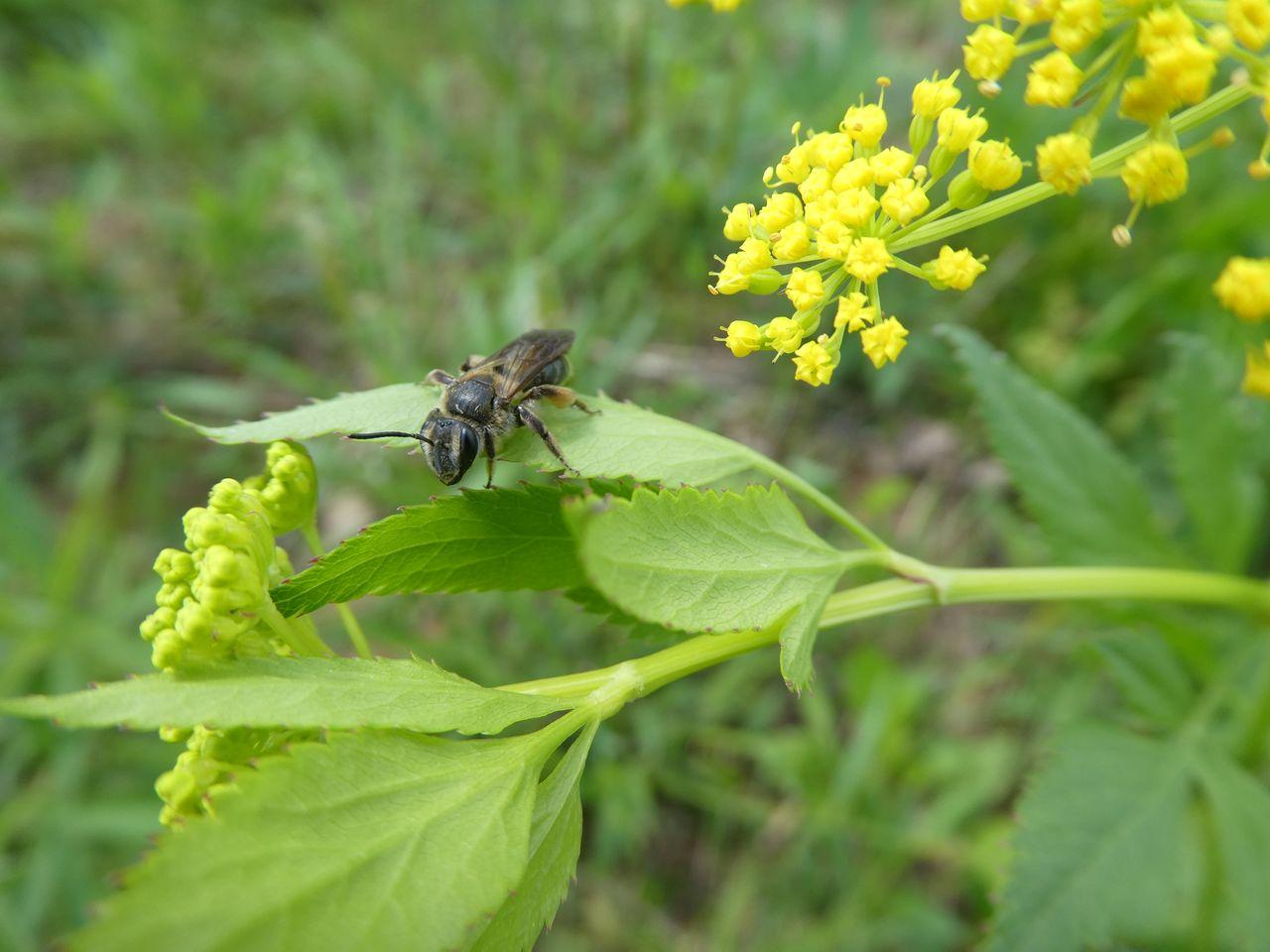
Mining bees (Genus Andrena)
Mining bees are some of the first bees to emerge in the springtime. Different species are active in the spring and fall, with the majority completing their lifecycle between March and June. They are small to medium-sized and dark-colored, sometimes with stripes of white hair on their abdomen. They have shallow depressions called fovea filled with light hair along the inner margin of their eyes. Mining bees are solitary– they do not live in colonies; instead, individual females work on their own to build a nest, lay eggs, and provision them with pollen. They build their nests in the ground by tunneling into bare soil.
Spring-flying mining bees are common pollinators of early-blooming perennial fruits like apples, blueberries, cherries, and peaches. Some species are specifically adapted to visit particular crops. For example, the Carolina Mining Bee (Andrena carolina) is a specialist on plants in the Ericaceae family, including blueberries and cranberries.
Blue orchard mason bee, Osmia lignaria. Photo: Steve Wells
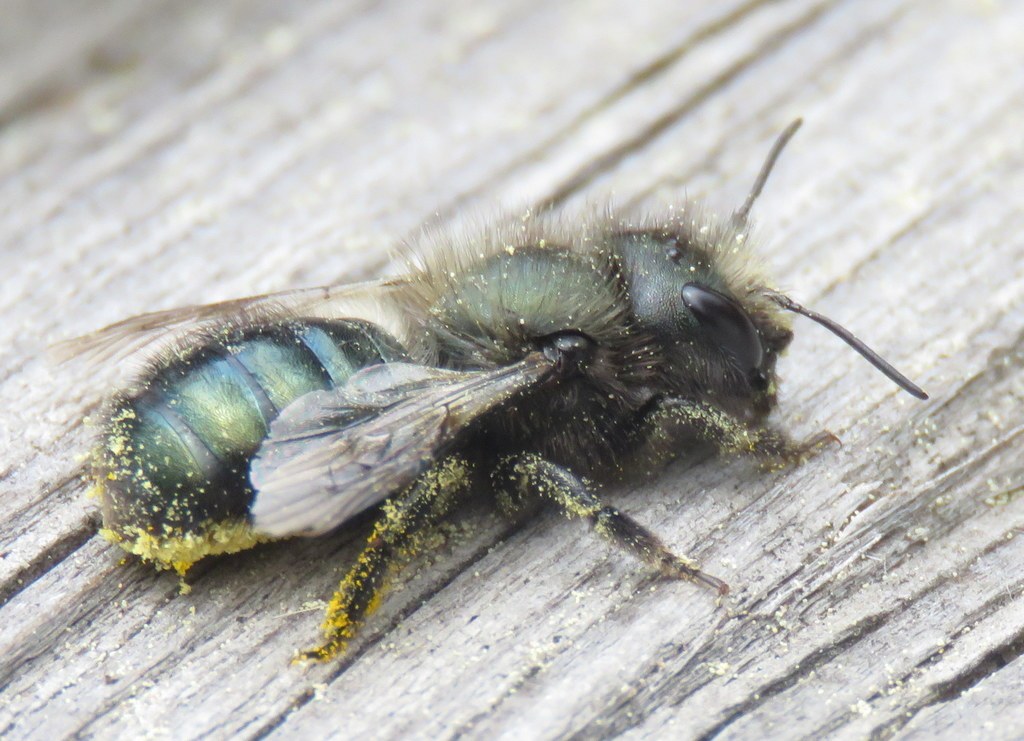
Mason bees (Genus Osmia)
Mason bees are another common springtime pollinator. These bees are medium-sized with a metallic sheen, often in a blue or blue-green hue. They carry pollen on the undersides of their abdomen, and often their entire belly is dusted with yellow or white pollen grains. Mason bees are solitary, and they build their nests in the hollow stems of plants or holes in dead wood. They plaster the inside of their nests with dried mud, which is where they get their common name. Mason bees will also nest in blocks of wood drilled with holes of the appropriate diameter (typically around 7 mm).
These bees are very efficient pollinators of orchard crops like apples and peaches. Their early activity periods often coincide with the bloom time of these perennial fruits. One species, the Blue Orchard bee (Osmia lignaria), is reared commercially and used for orchard pollination, primarily in the Western United States.
Bumble bee on purple coneflower. Photo: Amber Barnes
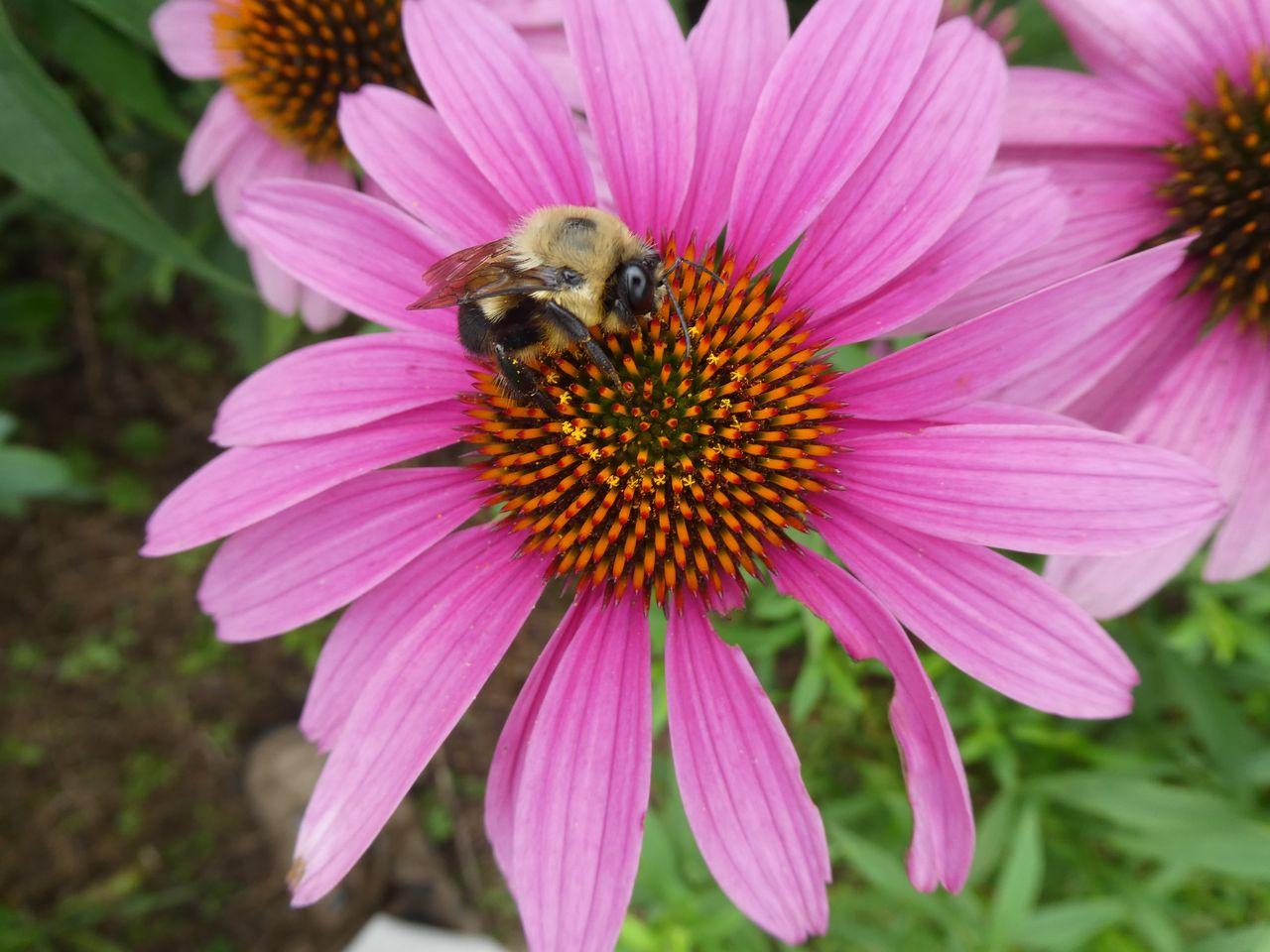
Bumble bees (Genus Bombus)
Bumble bees are among the largest and fuzziest bees in the Midwest. They are generally covered in black and yellow hair (though coloration can vary), and different species can be distinguished based on the arrangement of their stripes. Most bumble bees have a “pollen basket”, or corbicula, on their hind legs, which is a wide, flat, mostly hairless area which evolved to help these bees gather, pack, and transport balls of pollen and nectar to their nest. Bumble bees are typically social, meaning that they live in colonies with a queen bee and worker bees. They build nests in existing cavities on or near the ground, like old rodent burrows or beneath tussocks of bunchgrass.
Bumble bee life cycle. Photo: Jeremy Hemberger
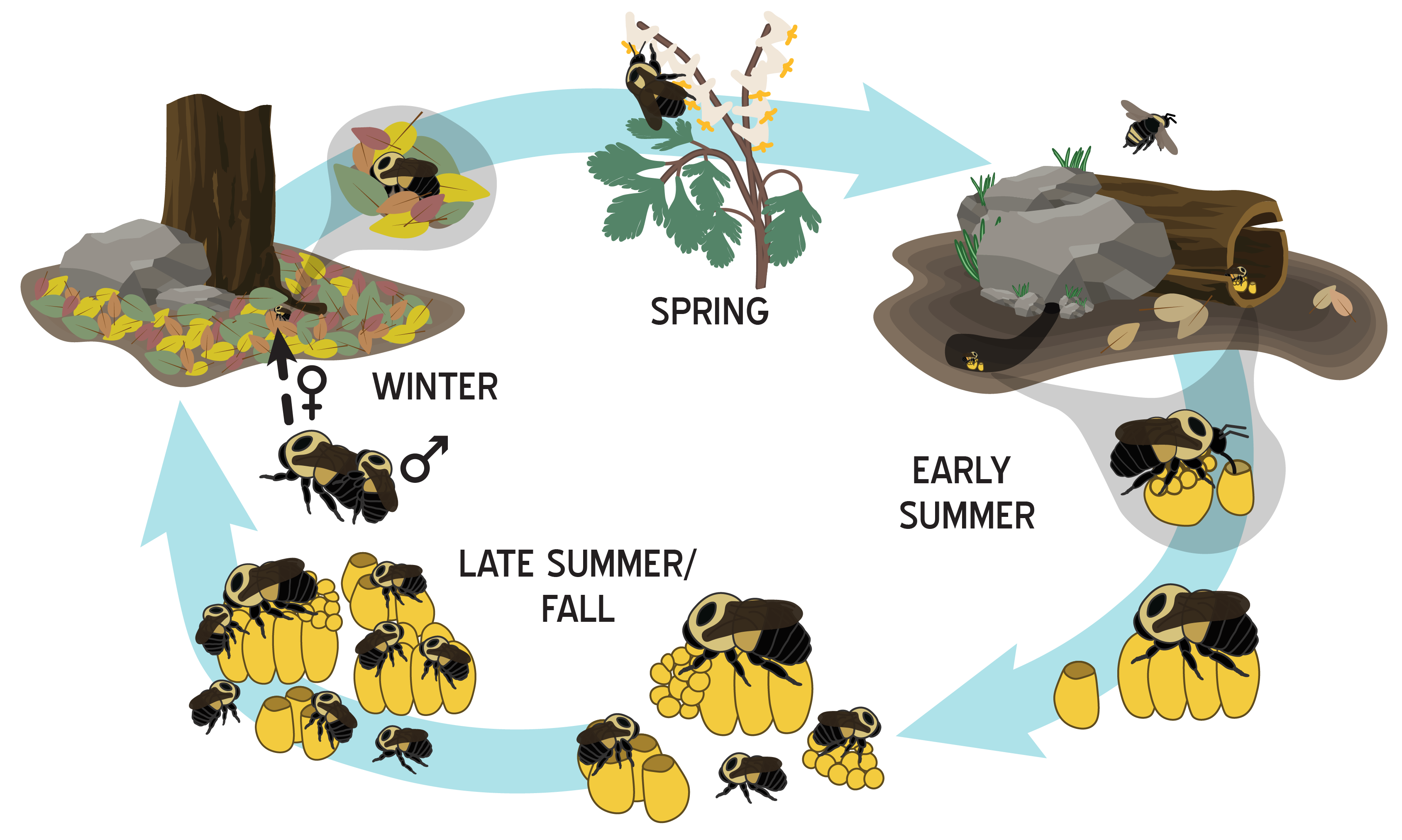
Because of their long activity period (early spring through late fall), bumble bees pollinate a wide variety of crops. Queens can be found visiting spring-blooming perennial fruits. Later in the summer, worker bees visit just about any flower they can find- they are not picky eaters! Bumble bees are particularly good pollinators of plants in the nightshade family, including tomatoes, peppers, eggplants, and potatoes. These flowers have a shape that makes it difficult to extract their pollen, but bumble bees have a behavior called “buzz pollination”, where they rapidly vibrate their flight muscles to eject the pollen, pollinating the flowers in the process.
Green sweat bee on aster. Photo: Amber Barnes
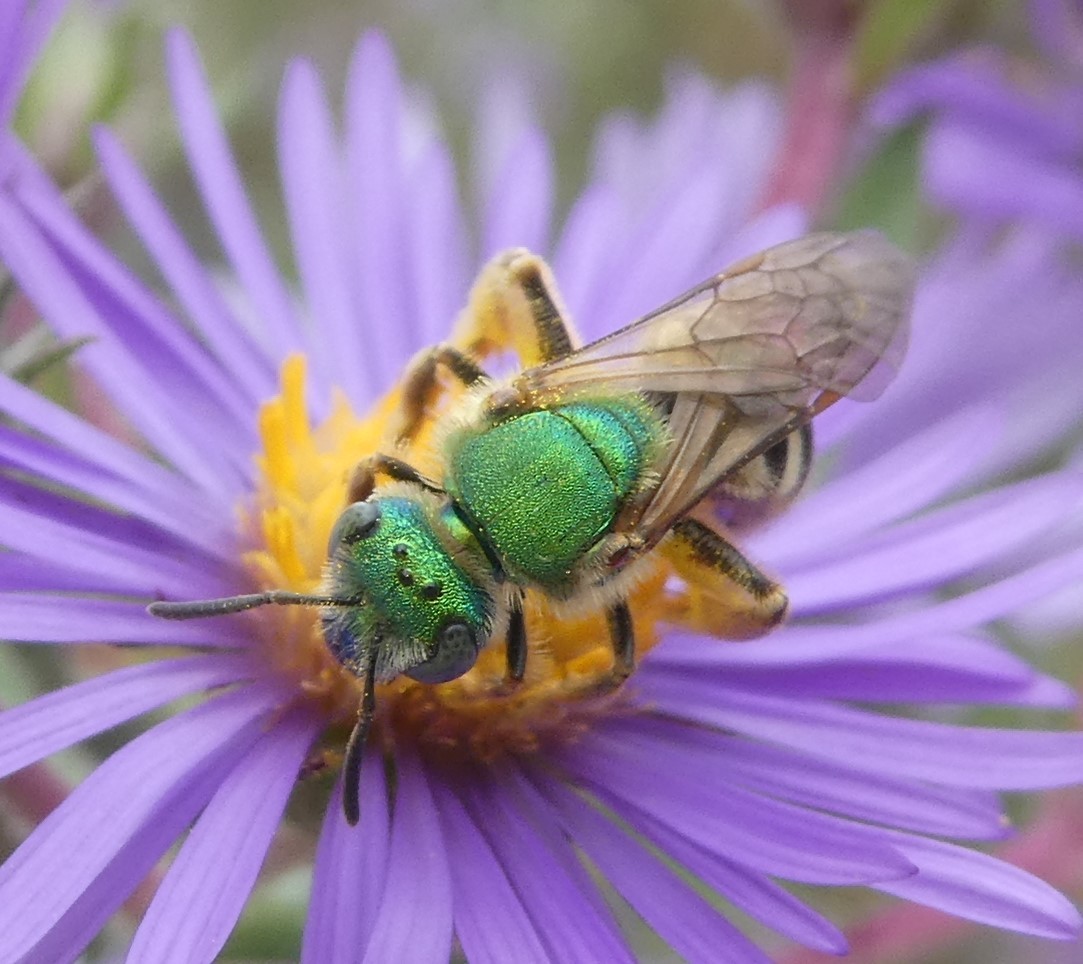
Sweat bees (Family Halictidae)
Sweat bees get their name from attraction to the salts in our sweat, which results in a tendency for them to land on people to gather those minerals. They are a highly diverse group of bees in many shapes and sizes, but they tend to be small. Some of them are bright metallic green, others are tiny and dully metallic, and still others are black with white stripes on their abdomen. Their activity periods and nesting habits are also varied. They are generally active from spring through fall. Many are solitary and nest in the ground, while others nest above ground in dead wood.
Because of their diversity of forms and habits, it’s no wonder that sweat bees pollinate a wide variety of crops. They are most abundant in the summertime, when things like watermelons, tomatoes, and pumpkins are in bloom. Although they are small in size, sweat bees are incredibly numerous, meaning they can make substantial contributions to pollination.
Squash bees in a squash blossom. Photo: Ilona Loser
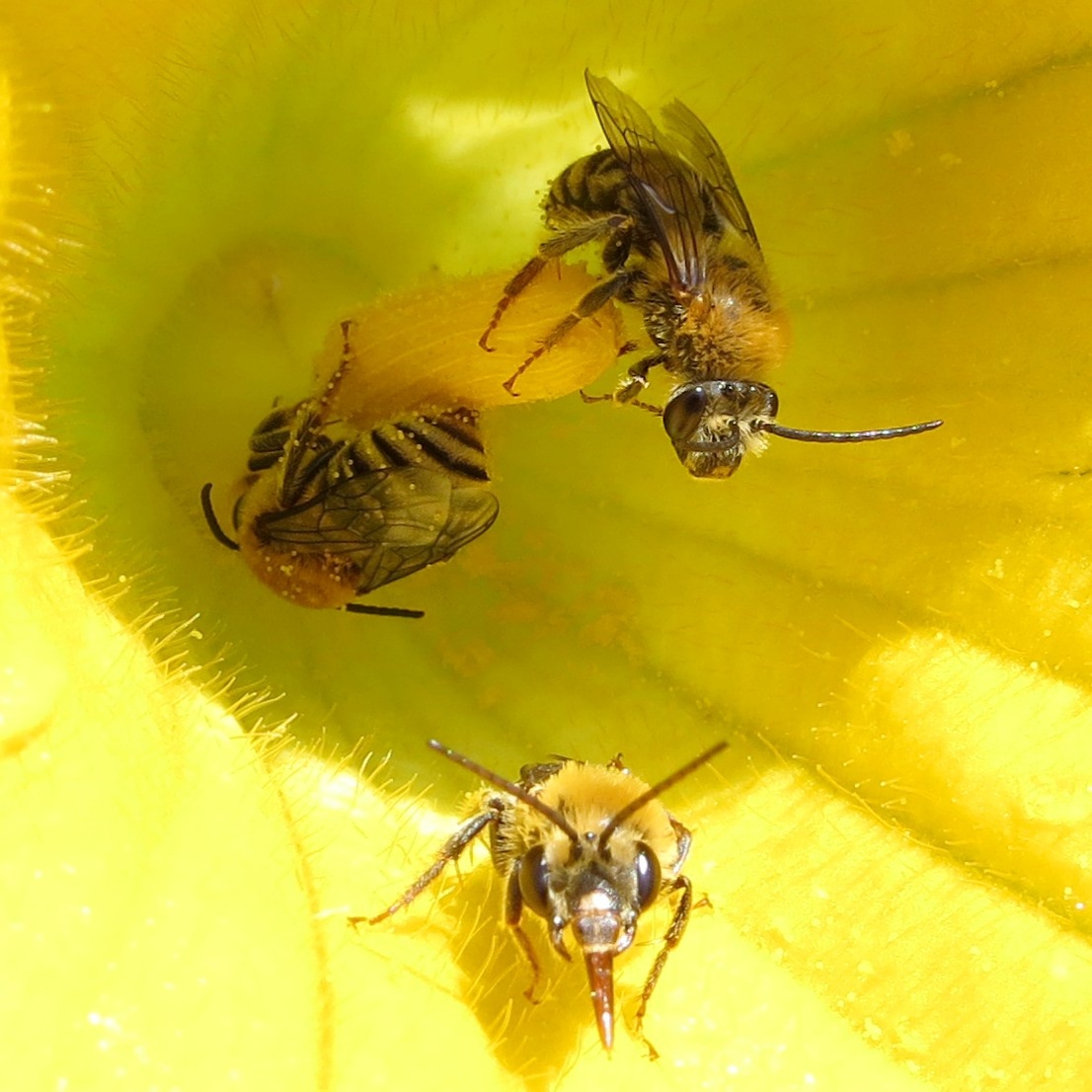
Squash bees (Peponapis pruinosa)
Squash bees are active in the summertime. They are similar in size and coloration to honey bees, including a black abdomen with white stripes. One way to differentiate squash bees is by their hind legs. Honey bees have “pollen baskets”, like bumble bees, while squash bees have long, abundant hairs all over their hind leg. Squash bees are Cucurbit specialists, so they only visit a narrow range of plants in the Cucurbit family. While they prefer to visit squash and pumpkin, they can also be found pollinating melons and cucumbers. They are solitary, and females build their nests in the ground. Squash bees are some of the most effective pollinators of cucurbit crops.
Supporting Native Bees in Specialty Crops
One of the best ways to support pollinators in agricultural areas is to plant native flowers for them. Crops that utilize honey bees for pollination can also benefit, because pollinator habitat supports native bees and honey bees alike. There are many opportunities to incorporate pollinator habitat into agricultural landscapes. Native plants can be established along field borders, in hedgerows, along riparian corridors, or even in flower strips within the crop production area (e.g., between orchard crop rows). Nesting habitat can also be included in native plantings by allowing for areas of bare ground, leaving dead plant stems, and pieces of dead wood or snags (standing dead trees).
Other ways to support pollinators in agricultural settings include limiting tillage and exposure to pesticides. Reducing or eliminating tillage prevents soil disturbance, preserving nesting areas for ground nesting bees. To protect pollinators from pesticides, include setback areas of at least 30 feet as no-spray zones between crop fields and pollinator habitat. Be conscientious about the timing and frequency of pesticide applications. It is best to apply late in the evening or early in the morning, before bees are active. Additionally, utilizing a threshold-based, Integrated Pest Management approach (rather than prophylactic calendar sprays) is one of the best ways to reduce usage of pesticides and the exposure risks they pose to pollinators.
Resources and Further Reading
Resources and Further Reading
Pollinator Partnership has a variety of guides available to help producers identify bees, establish pollinator habitat, and adopt pollinator-friendly management strategies.
- Agricultural Technical Guides – Regional and crop-specific guides to pollinator-friendly farming practices, including information on how to protect pollinators from pesticides.
- Bee Identification Guides – Short, state-specific visual guides to native bee identification.
- Bee Identification Booklets – A collection of longer-form publications with more detailed bee ID resources, including several bumble bee-specific resources.
- Ecoregional Planting Guides – Regional guides for pollinator-friendly native plant selection.
- Find Your Roots Tool – Build a personalized list of native plant recommendations for your habitat project.
- Indiana Specialty Crop Fact Sheets – Quick reference sheets for common specialty crops in the Midwest, including information on the pests, pollinators, and other beneficial insects in different crop systems.
- Working Lands for Wildlife – YouTube series highlighting methods of pollinator conservation in agricultural settings.
References
Stroh, Eleanor, et al. “Distinct Pollinator Communities Persist among Co-Flowering Specialty
Crops in Indiana.” Journal of Pollination Ecology 36 (October 2024): 269–83. https://doi.org/10.26786/1920-7603(2024)808.
Klein, Alexandra-Maria, et al. “Importance of Pollinators in Changing Landscapes for World
Crops.” Proceedings of the Royal Society B: Biological Sciences 274, no. 1608 (2006): 303–13. https://doi.org/10.1098/rspb.2006.3721.